Learn Kanji with Mnemonics
What is a mnemonic?
Used as an adjective, mnemonic (pronounced ni-mon-ik) means assisting or attending to assist memory. A mnemonic device, or just mnemonic, is a tool or technique for remembering something. For example, to remember the colors in a rainbow (Red, Orange, Yellow, Green, Blue, Indigo, and Violet) you could use the mnemonic "Richard Of York Gave Battle In Vain."
Why learn kanji with mnemonics?
A mnemonics-based system to learn kanji can help any student overcome all the challenges of learning kanji.
Let's be honest. Mastering kanji is difficult. Japanese children spend years and years, their entire childhood, learning kanji. Most people who want to learn Japanese as a second language don't have that much time to devote to learning kanji.
There are around 2000 characters that you must learn to be able to read most Japanese text. 2000! On top of that, each kanji can have multiple readings, which means the kanji can be pronounced in multiple ways. Kanji can have multiple meanings as well. That's a ton of information! Without a solid system for remembering all of this information, it's easy to get overwhelmed.
If fact, it is quite common for Japanese language students to become discouraged with their kanji progress and lose their motivation to keep going. They spend less time on kanji and focus more on other aspects of the Japanese language (grammar, listening, etc.).
Eventually, these students stop studying kanji altogether, often forgetting what little they have learned. It's not a surprise that most Japanese language students learn fewer than 200 kanji before giving up on the goal of mastering kanji.
Don't meet the same fate as these other students. Use a mnemonic system to help you accomplish your goal of mastering kanji.
Which mnemonic system should I use to learn kanji?
The simplest yet most complete mnemonic system to learn kanji is the K-FRU system. K-FRU, which stands for Kanji - For the Rest of Us, will help any kanji student perform the 5R's of kanji study: Recognize, Remember, Recall, Reproduce and Retain.
The 5R's of Kanji Study
- Recognize - When you see a kanji, you know immediately whether or not you have studied it.
- Remember - You know the meaning of the kanji and how to pronounce it.
- Recall - When you think of a kanji, or you hear a word using a kanji, you can see the shape and form in your mind.
- Reproduce - Having recalled a kanji, you are able to draw the strokes of the kanji with your hand.
- Retain - As you learn new kanji, you continue to recognize, remember, recall, and reproduce previously learned kanji. In other words, you have a high rate of kanji retention over time.
Why use the K-FRU system to learn kanji?
Through the use of mnemonic sentences, the K-FRU system will help you learn the nearly 2000 characters you need to master kanji, including their meanings and their readings. You will recognize, remember, recall, reproduce, and retain each kanji.
In the K-FRU system, there is one mnemonic sentence for every kanji. This sentence will tell you a) how to write the kanji, b) the meaning of the kanji in English, and c) how to pronounce the kanji's Chinese, or "ON" reading. Yes! All in one sentence!
By remembering the sentence, you will quickly achieve the 5R's for that kanji. You will recognize the kanji and remember its meanings and pronunciation. You will be able to recall its form and strokes in your mind, allowing you to reproduce it in written form. Furthermore, because each sentence is unique and memorable, as you learn more and more advanced kanji, even as you come close to learning nearly 2000 kanji, you will be able to retain every kanji all the way back to the beginning of your kanji studies.

A Better Way to Study Kanji

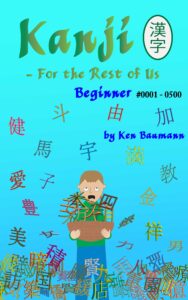
Kanji - For the Rest of Us

How do Japanese students study kanji?
Japanese children study kanji gradually throughout their entire primary and secondary education. Primary students will be introduced to kanji little-by-little each grade. By the end of 6th Grade, they will know approximately 1026 kanji. Upon Graduation from high school, they should know around 2000 kanji. This article by Abe Spiegel  goes into more detail on how Japanese schools introduce kanji gradually.
How do Japanese school students learn kanji? Mostly through repitition and practice. They write each kanji over and over, practicing the strokes in the proper order. There are grade-specific drill books to help with repitition. Japanese teachers will use other techniques to help the children remember, including using mnemonics, flash cards and games, along with quizes and testing.
Finally, Japanese children do a lot of reading practice, of course, in story books, textbooks, and homework, but also in the signs at school, at the station, and around town. They will see kanji on their menu in a restaurant, on their phones and computers, in game software, apps, and on the internet, and all over TV. Indeed, Japanese children encouter kanji throughout their school and home life. Being surrounded by kanji helps them to quickly learn and retain kanji.
One of the biggest advantages Japanese children have when learning kanji, however, is time. They have their entire childhood to learn. Time is a luxury that most of us do not have when it comes to learning kanji. Most non-Japanese students who are trying to learn kanji as part of their Japanese language studies will become frustrated by trying to learn kanji the way Japanese children do. Read more about it here...